Prefabricated façades will mark the definitive shift towards faster, more efficient and more sustainable construction
- Industry stakeholders highlight the need to design from the outset, certify complete systems and strengthen collaboration to drive industrialisation in the construction sector.
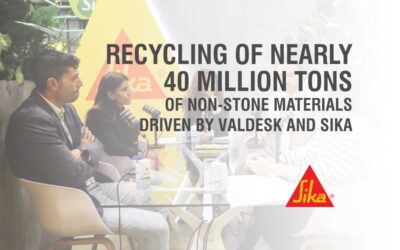
- Sika brings together experts in industrialised façades in the latest episode of its video podcast, the Sika 30/50 Challenge.
Madrid, 7 May 2026.- Facades are playing an increasingly prominent role in the construction sector’s transformation towards industrialisation, digitalisation and reducing the environmental impact of buildings. The building envelope is evolving from traditional solutions towards highly technical systems capable of improving energy efficiency, optimising construction times and ensuring higher quality standards.
Beyond its aesthetic function, the building envelope is establishing itself as a strategic element that brings together innovation, technical performance and the ability to integrate different construction systems. However, this progress also presents new challenges, particularly in areas such as certification, performance validation and coordination between the various stakeholders involved.
Against this backdrop, the sector agrees that the real leap towards industrialisation lies in treating façades as complete systems, designed from the outset and backed by testing and certification that guarantee their performance over time.

This was highlighted by Vanesa Álvarez, KAM Modular Building at Sika; Antonio Mescua, Country Manager at Aquapanel (Knauf); and José Valverde, Director of the Technical Office at Lignum Tech, during the recording of the latest episode of the video podcast “Sika 30/50 Challenge”, entitled “Industrialised façades: the building’s most high-tech skin”.
From the perspective of manufacturers and system integrators, the industrialised façade is set to lead the growth of the off-site model and act as a driving force for industrialisation.
“The façade will be the key element in making that leap in the sector’s industrialisation. Just as happened in the past with industrialised bathrooms, the façade is now in a position to drive the exponential growth we all hope for, because it allows us to view construction as a complete system, with quality and guarantees,” says Vanesa Álvarez, KAM Modular Building at Sika.
In this context, moving processes to the factory allows for improved control, quality and safety, as well as optimising execution times.
Addressing the sector’s challenges: deadlines and labour
One of the main arguments in favour of industrialisation is its ability to address structural problems in the sector, such as labour shortages and the need to build faster and better. “We’re not just talking about improving quality or working faster. Industrialisation also solves a key problem in the sector, which is attracting labour. It allows us to work in more controlled, safer environments, without being dependent on the weather and with much more organised processes, which makes the sector more attractive to new professionals,” explains Antonio Mescua, Country Manager at Aquapanel (Knauf).
Furthermore, this model allows for a significant reduction in construction times, with the consequent impact on costs and the overall efficiency of the project.
Experts agree that industrialisation cannot be applied as an additional layer on top of a traditional project, but must be integrated from the initial design phase, involving all stakeholders.
“Trying to industrialise a project that is already fully defined is very complicated. The key is to get involved in the design phase from the very start, working alongside the architect and adapting the system to the building’s concept. Design is the fundamental phase for an industrialised project to succeed,” emphasises José Valverde, Director of the Technical Office at Lignum Tech.
This approach also allows for the creative freedom of architecture to be maintained, integrating industrialisation as a tool rather than a limitation.
Another major change is the shift from working with isolated products to developing complete building systems, where all components interact and must be validated together.
“Industrialisation goes hand in hand with certification. We often talk about innovative solutions, but if they are not certified and do not provide that certainty to the market, it is very difficult for them to be adopted. That is why it is key to work on joint certifications that validate the complete system and not just each product separately,” highlights Vanesa Álvarez.
Tests such as fire resistance, airtightness, hygrothermal performance and wind loads become essential elements in ensuring the performance and durability of these solutions.
The need to develop and certify complete systems is driving new dynamics of collaboration between companies, leaving behind more fragmented models.
“To tackle this type of solution, working independently is no longer viable. We have to come together, integrate technologies and develop complete systems. Only then can we meet current market demands and ensure that the solutions work as a whole,” notes Mescua.
This paradigm shift also translates into greater coordination between manufacturers, engineering firms and developers, reinforcing the idea of construction as an industrial process.

About SIKA
The SIKA Group is a multinational company specialising in chemical products. It supplies the construction sector (building and civil engineering) and industry (transport, automotive, solar and wind power plants, façades, etc.). SIKA is a leading manufacturer of materials for sealing, bonding, waterproofing, repairing, reinforcing and protecting structures. It operates in 103 countries, with 400 factories and approximately 34,000 employees worldwide; the company generated sales of €12.465 billion in 2024.