Through VALDESC, Sika is driving the recycling of around 40 million tonnes of non-aggregate materials
- The consortium promotes public-private partnerships to address the challenges of circularity in construction, with a focus on recycling complex materials such as insulation, including wool and plaster.
- Sika is part of this initiative, making its expertise available to partners and acting as an “enabler of all these processes” through the use of its technology.
- The company discusses the challenges of this initiative alongside Surge Ambiental, Cementos La Cruz and Tecnalia in a new episode of the video podcast Desafío 30/50.
Madrid, 5 June 2026.- The transition towards a climate-neutral built environment requires a profound transformation of the construction process, taking into account the entire life cycle of a building, from its design to the end of its useful life, with particular attention to the revaluation, recovery and reuse of resources.
However, this process is complex and the technologies for its implementation are still being developed. “With an annual generation volume of between 35 and 40 million tonnes of Construction and Demolition Waste (CDW), the real challenge lies in recycling non-mineral materials of high technical complexity, such as technical plastics, plasters or insulation materials like wool,” explains Jaime Moreno, researcher and project manager at Tecnalia. “The challenge is no longer simply to recycle, but to prevent these materials from ending up in landfill due to their low density, heterogeneity or the presence of contaminants, by reintegrating them into the value chain with full technical guarantees.”

It is from this need that VALDESC has emerged, an R&D&I project funded by the Community of Madrid under a public-private partnership model, bringing together a total of 11 strategic partners, including Surge Ambiental, Tecnalia, Cementos La Cruz and Sika.
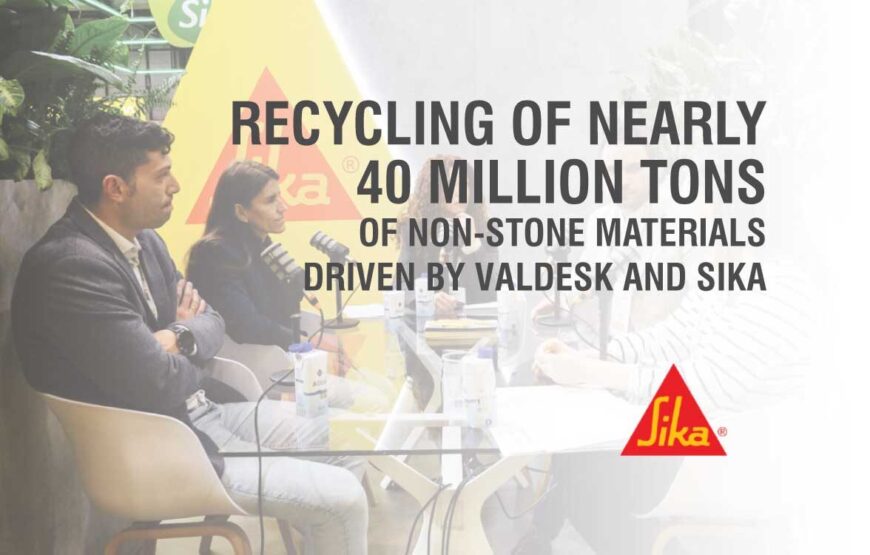
In the latest episode of the Desafío 30/50 podcast, Cristina Valverde, Head of R&D – Concrete at Sika Spain, Jaime Moreno, researcher and project manager at Tecnalia, Juan Diego Berjón, Head of Waste Management Services at Surge Ambiental, and Pilar Hidalgo, Director of Innovation at Cementos La Cruz, analyse and discuss the challenges, needs and progress of this initiative, “which focuses specifically on the recovery of complex construction and demolition waste and on the digitalisation of the supply chain using advanced tools”, noted Juan Diego Berjón.
Eco-design and a rigorous manufacturing process
Among the main obstacles to progress in circularity in construction is the difficulty in achieving a consistent flow of materials. On-site recovery is complex, and a constant, predictable supply flow for manufacturing plants cannot yet be guaranteed.
“This project allows us to sit down with the end consumer of the recycled product so they can specify exactly how they need the material, which speeds up time to market. For this to work, we must be able to guarantee companies such as SIKA a consistent product quality in a specific volume; the supply cannot fail,” stated Juan Diego Berjón.
From an operational and logistical perspective, Berjón pointed out that it is essential to change the current paradigm by implementing eco-design in new construction solutions and planning for their future dismantling.
Another key issue to address is the “myth that construction materials made from recycled raw materials are of lower quality”, noted Pilar Hidalgo; rigorous process control demonstrates that “materials based on CDW are not synonymous with low quality, and can even outperform the original product”, as has been achieved by incorporating crushed mineral wool into decarbonised cement matrices.
In this multifaceted process, the manufacturer’s role is to act as the indispensable enabler for transforming complex waste into useful and economically viable products. Sika plays a cross-cutting role by developing solutions with low environmental impact, where innovation is applied to meet the sector’s needs. “At SIKA, we are involved in many tasks, providing support through various solutions; our role in all these tasks is to facilitate these processes using grinding additives, cement modifiers and water reducers designed for each specific need,” explained Cristina Valverde.

This circularity strategy is directly aligned with the company’s global initiatives, highlighting the framework and technology behind the international Sika Circular Concrete campaign, which focuses on closing the concrete life cycle and promoting maximum efficiency in the use of secondary raw materials on a global scale.
The full episode is available to listen to on Spotify, iVoox and on Sika’s YouTube channel.
About SIKA
The SIKA Group is a multinational company specialising in chemical products. It supplies the construction sector (building and civil engineering) and industry (transport, automotive, solar and wind power plants, façades, etc.). SIKA is a leading manufacturer of materials for sealing, bonding, waterproofing, repairing, reinforcing and protecting structures. It operates in 103 countries, with 400 factories and approximately 34,000 employees worldwide; the company generated sales of €12.465 billion in 2024.